This me and my friends

Selamat datang di blog saya

Me and my friend XII Multimedia U

Terima kasih telah berkunjung

aku dan teman-temanku

Moment pas Porseni

Gokil disela-sela kerja bakti

Kebersamaan adalah keindahan

This is me

Welcome to my blog

Showing posts with label Produktif. Show all posts

Wednesday, October 9, 2013

Technical editing


Technical editing involves reviewing text written on a technical topic, and identifying usage errors and ensuring adherence to a style guide. Technical editing may include the correction of grammatical mistakes, misspellings, mistyping, incorrect punctuation, inconsistencies in usages, poorly structured sentences, wrong scientific terms, wrong units and dimensions, inconsistency in significant figures, technical ambivalence, technical disambiguation, correction of statements conflicting with general scientific knowledge, correction of synopsis, content, index, headings and subheadings, correcting data and chart presentation in a research paper or report, and correcting errors in citations.
In large companies, experienced writers are dedicated to the technical editing function. In organizations that cannot afford dedicated editors, experienced writers typically peer-edit text produced by their less experienced colleagues.
It helps if the technical editor is familiar with the subject being edited, but that is not always essential. The "technical" knowledge that an editor gains over time while working on a particular product or technology does give the editor an edge over another who has just started editing content related to that product or technology. But essential general skills are attention to detail, the ability to sustain focus while working through lengthy pieces of text on complex topics, tact in dealing with writers, and excellent communication skills.

Saturday, October 5, 2013

Adobe Photoshop

Adobe Photoshop, or so-called Photoshop, Sotosop is made in the image editor software Adobe Systems is devoted to editing photos / drawings and manufacturing effects. The software is widely used by digital photographers and advertising company that is considered as the market leader (market leader) for image processing software, and, together with Adobe Acrobat, is regarded as the best product ever produced by Adobe Systems. Eighth version of the application is called by the name of Photoshop CS (Creative Suite), version called Photoshop CS2 nine, ten version called Adobe Photoshop CS3, and a version of the last (eleventh) was Adobe Photoshop CS4.


Photoshop is available for Microsoft Windows, Mac OS X, and Mac OS; versions 9 and above can also be used by other operating systems such as Linux using software such as CrossOver.


DevelopmentIn 1987, Thomas Knoll, a PhD student at the University of Michigan, began writing a program on his Macintosh Plus to display grayscale images on a monochrome display. This program, called Display, caught the attention his brother John Knoll, an employee at Industrial Light & Magic, who recommended Thomas to change the program into a full image editing program. Thomas took a six month break from his studies in 1988 to collaborate with his brother on the program, which has been renamed ImagePro. Later that year, Thomas changed the name of the program into Photoshop and work in the short term Barneyscan scanner manufacturers to distribute copies of the program with a slide scanner; "total of about 200 copies of Photoshop has shipped" this way.During that time, John traveled to Silicon Valley in California and gave a demonstration of the program to engineers at Apple Computer Inc. and Russell Brown, art director at Adobe. Both demonstrations were successful, and Adobe decided to purchase the license to distribute in September 1988. While John worked on plug-ins in California, Thomas remained in Ann Arbor to write program code. Photoshop 1.0 was released in 1990 for Macintosh.FeaturesAlthough it was originally designed to edit images for paper-based printing, Photoshop is also used to produce images for the World Wide Web. Some versions also include an additional application, Adobe ImageReady, for this purpose.Photoshop also has strong ties with some software for media editing, animation, and other Adobe authoring. Native Photoshop file format,. PSD, can be exported to and from Adobe ImageReady. Adobe Illustrator, Adobe Premiere Pro, After Effects, and Adobe Encore DVD to make professional DVDs, provide non-linear image editing and special effects services such as backgrounds, textures, etc for television, movies, and websites. For example, Photoshop CS broadly supports making menus and buttons (button) DVD.Photoshop can accept the use of multiple color models:

    
• RGB color models
    
• Lab color models
    
• CMYK color models
    
• Grayscale
    
• Bitmap
    
• duotoneThe latest version, released in 2005, is version 9. The program is marketed under the name "Photoshop CS2." "CS" reflects its integration with applications Photoshop "Adobe Creative Suite and is called" 2 "because it is the second version released since Adobe to integrate the two products. There are some in addition to Photoshop CS2 such as multiple layer and selecting" warp, " curve version of the transform tool and the color replacement tool, previously present as a plug-in 8BF.For photography enthusiasts, Adobe provides a filter "reduce grain" (reduced grain) that can help optimize photos taken in low light. To "clarify" CS product differences with previous products Photoshop, Adobe Photshop eliminate eye symbol, which was presented in a form different from version 3 to version 7. Photshop CS and CS2 now use fur as an icon and a form of identification.Icons for Photoshop CS3 Beta.Photoshop CS3 beta version has been released for CS2 users on December 15, 2006. Unlike Photoshop CS and CS2 using feathers as its logo, Logo for the third edition of this form of typography, with the letters 'Ps' white and blue background gradient.Camera RAW 3.xThe latest version comes with Adobe Camera RAW, a plugin developed by Thomas Knoll which can read multiple formats of digital camera RAW files and import them directly into Photoshop. The initial version of the RAW plugin for Photoshop 7.0.1 is also available with an additional cost of $ 99 USD.While Photoshop is the industry standard image editing program aimed at profsional raster charts, the price offered is quite high, approximately U.S. $ 600. This situation provoked a few programmers to design the graphics hardware (graphics tools) with a more affordable price. To compete in this market, and to counter piracy products, Adobe introduced Photoshop Elements, a version of Photoshop is more minimalist, with affordable prices; under U.S. $ 100. This product is intended for home users and eliminates many professional features.File FormatPhotoshop has the ability to read and write raster and vector image format such as. Png,. Gif,. Jpeg, and others. Photoshop also has some typical file formats:

    
. PSD (Photoshop Document) format stores an image in the form of layers, including text, masks, opacity, blend modes, color channels, alpha channels, clipping paths, and duotone settings. Popularity photoshop create this file format is widely used, thus forcing programmers other image editing program to add the ability to read PSD formats in their software.
    
. PSB 'is the latest version of the PSD designed for files larger than 2 GB
    
. PDD is another version of the PSD that only supports the features of the software PhotshopDeluxe.
ToolTool in Adobe Photoshop is a tool that can help users in editing. Adobe Photoshop CS3 memilikit 59 tools that can be used by the user. Tool - The tool consists of various tools with specific uses. Some of the tools - the tools available in Photoshop, among others:

    
• History Brush Tool
    
• Eraser Tool
    
• Path Selection Tool
    
• Direct Selection tool
    
• Pen Tool
    
• Shape Tool
    
• Brush Tool
    
• Audio Annotation Tool
    
• Eyedropper Tool
    
• Measure Tool
    
• Text Tool
    
• Hand Tool

Operating the camera handy cam

measures operate the camera:

   1.  Remove the lens cap
   2. Move the power switch of the camera by pressing and hold the lock button, then press
   3.  Open the LCD screen, LCD screen with the push of a button, then open to the direction of the arrow. The viewfinder automatically turns off
   4.   Press the start / stop to start recording. Press the start / stop again to stop recording

   The measures put the tape in the camera handy cam is:

   5.  Press the direction of the arrow and open the lid
   6. Insert cassette tapes with glass window position visible from the top and hit the back of the middle of the tape
    7.  After the cassette holder is automatically dropped to the bottom and press the ribbon cover

Editing Video

For this article I will share with my friends about video editing stories, what is the video editing, well from his words also caught video ediiting, yes means editing the video. The steps that I used to do in mendegit video are as follows:1. Taking videoIn video capture, many ways to do as for the ways friends can be learned by looking at other sources because here I can not elaborate on the techniques of shooting.2. video captureWhat is the capture, of the sense that I make myself are capturing is a way to transfer video data from tape to the form of data that can be received on a computer (confused huh ...?) May point to say is move data capture video from tape to the computer. The various formats of video files that are commonly used when capture is a format avi or mpeg ga. But in general, avi, this is because of the type mentahan avi files can be imported into adobe premiere to do editing. Beside that avi video file has better quality, but in pity remain very considerable size. For the type of mpeg files, not all can be imported into a video editing software. But with the type of mpeg files are generally smaller than the avi to video capturean with the same duration.3. EditingAfter the video capture, this is a core part of the video editing, the editing part, as for the software that is commonly used for video editing is Pinacle, Adobe Premiere, Ulead, Movie Maker etc.. The additional tools-tools commonly in use for additional is 3dmax, Flash, Amor (to change into another swf file video files such as avi, mov, etc.), and astro (software that generates text file type swf). Many techniques are commonly used in editing among other techniques often used is a blue screen techniques easiest ya ya if we edit the video using adobe premiere (out I've nyobanya use it) by using a blue screen then all the blue the video will be seen does not exist. There are many other possible teknik2 which I will write in this blog in a different part, this is because there are techniques that can be used only on certain software. But now that the technology is very advanced software once, then editing technique is less noticed because it has much effect fasilitas2 video which is provided directly by video editing software.4.RenderWhat is the rendering, from my own understanding can be said to unite renders frame-edited video that we have, from a variety of videos that we cut into pieces, and we join in jadiin into one video file, while the results of the video files are plain resulting from the rendering is avi and mpeg too, oh yes we are currently making a video using PAL mode, I also do not know why, but for the region's outstanding televisi2 Indonesia said the support the same video with the type of PAL. From the results of this renderan video file we can change again to DVD, VCD, RMVB and so by using converter software.
That's four main steps are commonly used in video editing. For more details about how pengcapturean, the tools used in performing pengcaputeran I will explain in the next article, as well as a variety of techniques in video editing and shooting techniques. Thank you so ...

Animation

Animation is the rapid display of a sequence of images to create an illusion of movement. The most common method of presenting animation is as a motion picture or video program, although there are other methods. This type of presentation is usually accomplished with a cameraand a projector or a computer viewing screen which can rapidly cycle through images in a sequence. Animation can be made with either hand rendered art, computer generated imagery, or three-dimensional objects, e.g. puppets or clay figures, or a combination of techniques. The position of each object in any particular image relates to the position of that object in the previous and following images so that the objects each appear to fluidly move independently of one another. The viewing device displays these images in rapid succession, usually 24, 25 or 30 frames per second.

[edit]History

Five images sequence from a vase found in Iran
An Egyptian burial chamber mural, approximately 4000 years old, showing wrestlers in action. Even though this may appear similar to a series of animation drawings, there was no way of viewing the images in motion. It does, however, indicate the artist's intention of depicting motion.
Early examples of attempts to capture the phenomenon of motion drawing can be found in paleolithic cave paintings, where animals are depicted with multiple legs in superimposed positions, clearly attempting to convey the perception of motion.
A 5,000 year old earthen bowl found in Iran in Shahr-i Sokhta has five images of a goat painted along the sides. This has been claimed to be an example of early animation. However, since no equipment existed to show the images in motion, such a series of images cannot be called animation in a true sense of the word.
A Chinese zoetrope-type device had been invented in 180 AD.The phenakistoscope, praxinoscope, and the common flip bookwere early popular animation devices invented during the 19th century.
These devices produced the appearance of movement from sequential drawings using technological means, but animation did not really develop much further until the advent of cinematography.
There is no single person who can be considered the "creator" of film animation, as there were several people working on projects which could be considered animation at about the same time.
Georges Méliès was a creator of special-effect films; he was generally one of the first people to use animation with his technique. He discovered a technique by accident which was to stop the camera rolling to change something in the scene, and then continue rolling the film. This idea was later known as stop-motion animation. Méliès discovered this technique accidentally when his camera broke down while shooting a bus driving by. When he had fixed the camera, a hearse happened to be passing by just as Méliès restarted rolling the film, his end result was that he had managed to make a bus transform into a hearse. This was just one of the great contributors to animation in the early years.
The earliest surviving stop-motion advertising film was an English short by Arthur Melbourne-Cooper called Matches: An Appeal(1899). Developed for the Bryant and May Matchsticks company, it involved stop-motion animation of wired-together matches writing a patriotic call to action on a blackboard.
J. Stuart Blackton was possibly the first American film-maker to use the techniques of stop-motion and hand-drawn animation. Introduced to film-making by Edison, he pioneered these concepts at the turn of the 20th century, with his first copyrighted work dated 1900. Several of his films, among them The Enchanted Drawing (1900) and Humorous Phases of Funny Faces (1906) were film versions of Blackton's "lightning artist" routine, and utilized modified versions of Méliès' early stop-motion techniques to make a series of blackboard drawings appear to move and reshape themselves. 'Humorous Phases of Funny Faces' is regularly cited as the first true animated film, and Blackton is considered the first true animator.
Fantasmagorie by Emile Cohl, 1908
Another French artist, Ã‰mile Cohl, began drawing cartoon strips and created a film in 1908 called Fantasmagorie. The film largely consisted of a stick figure moving about and encountering all manner of morphing objects, such as a wine bottle that transforms into a flower. There were also sections of live action where the animator’s hands would enter the scene. The film was created by drawing each frame on paper and then shooting each frame onto negative film, which gave the picture a blackboard look. This makesFantasmagorie the first animated film created using what came to be known as traditional (hand-drawn) animation.
The author of the first puppet-animated film (i.e. The Beautiful Lukanida (1912)) was the Russian-born (ethnically Polish) director Wladyslaw Starewicz, known as Ladislas Starevich.
Following the successes of Blackton and Cohl, many other artists began experimenting with animation. One such artist was Winsor McCay, a successful newspaper cartoonist, who created detailed animations that required a team of artists and painstaking attention for detail. Each frame was drawn on paper; which invariably required backgrounds and characters to be redrawn and animated. Among McCay's most noted films are Little Nemo (1911), Gertie the Dinosaur (1914) and The Sinking of the Lusitania (1918).
The production of animated short films, typically referred to as "cartoons", became an industry of its own during the 1910s, and cartoon shorts were produced to be shown in movie theaters. The most successful early animation producer was John Randolph Bray, who, along with animator Earl Hurd, patented the cel animation process which dominated the animation industry for the rest of the decade.
El Apóstol (Spanish: "The Apostle") was a 1917 Argentine animated film utilizing cutout animation, and the world's first animated feature film.
Computer animation has become popular since Toy Story (1995), the first animated film completely made using this technique.
In 2008, the animation market was worth US$68.4 billion.

Thursday, October 3, 2013

Photograph


Teknik Pencahayaan dalam Fotografi
    Sebelumnya pernah dibahas tentang cahaya buatan (articial lighting). Kali ini akan dibahas beberapa teknik lighting yang umum digunakan. Mengacu pada pemahaman fotografi sendiri yang berarti ‘melukis dengan cahaya’ maka tanpa adanya suatu cahaya tidak akan karya fotografi. Permainan cahaya dan teknik pencahayaan yang benar akan menghasilkan karya foto yang bagus. Ada beberapa istilah dan teknik pencahayaan dalam fotografi.
  1. Hi Key
  2. Low Key
  3. Candle Light
  4. Split
  5. Horror
  6. Butterfly
  7. Rembrandt

High Key Lighting
High Key Lighting
High Key Lighting
Teknik pencahayaan yang menghasilkan warna sangat kontras yang di dominasi oleh warna terang, biasanya warna putih. Kesan yang dihasilkan adalah bersih, putih, suci, lembut. Paling sesuai biasanya untuk fotografi produk, kosmetik, dan jenis foto yang memerlukan penguatan pada produk.


Low Key Lighting
Low Key Lighting
Low Key Lighting
Low Key lighting sebenarnya mirip dengan teknik hi-key, sama-sama menonjolkan kontras dari sebuah objek foto. Bedanya terletak pada eksekusi serta hasil akhir. Pada foto low key pencayahaan sangat minim, hanya ditekankan pada bagian-bagian tertentu objek foto. Foto ini sangat cocok untuk menampilkan kesan sedih, dalam, eksotis, mistis, dan sebagainya.
Setting lampu biasanya sangat minim. Bisa menggunakan satu jenis lampu atau dua untuk menghasilkan detail dan kedalaman foto.


Candle Light
Candle Light
Candle Light - Photo by: Tuhin


Hasil dari teknik pencahayaan ini mirip dengan Low Key. Bedanya terletak pada sumber cahaya yang digunakan, biasanya dari lilin atau sumber cahaya lain yang mirip lilin. Foto yang dihasilkan memberi kesan dalam, kuat, damai, dan teduh.
Teknik ini kebanyakan digunakan untuk foto-foto religius, produk, dan jenis foto lain yang ingin memberikan kesan damai dan teduh seperti karakter lilin. Karena sumber cahaya terbatas, teknik foto dengan kecepatan rendah.

Split Lighting
Split Lighting - Photo by: Samantha
Split lighting teknik pencahayaan dengan menggunakan lighting dari salah satu sisi objek foto. Hasilnya objek terlihat separo dari keseluruhan objek foto. Banyak diimplementasikan pada jenis foto portrait atau objek simetris. Kesan yang ditimbulkan bermacam-macam, tergantung dari keperluan foto dibuat. Bisa misterius, penekanan karakter objek dan sebagainya.


Horror Lighting
Horror Lighting
Horror Lighting - Photo by: Ekillian
Teknik foto horor hampir mirip dengan teknik low light dan split lighting, perbedaannya hanya pada angle pengambilan objek foto dan sudut penempatan lampu serta ekspresi model. Kebanyakan posisi lampu diletakkan di bawah model.


Butterfly Lighting
Butterfly Light
Butterfly Light - Photo by: Oneslidefotography.com
Teknik lighting ini menempatkan lampu utama di atas objek foto. Sehingga dihasilkan foto dengan bayangan di bawah hidung menyerupai atau mirip bentuk kupu-kupu. Lighting jenis ini sangat cocok untuk foto kosmetik yang menonjolkan kecantikan objek foto.


Rembrandt Lighting
Rembrant Light
Rembrandt Light
Teknik ini menggunakan satu atau dua lampu dan ditambah reflektor. Jenis pencahayaan ini banyak digemari karena menghasilkan foto yang lebih berdimensi bahkan dengan peralatan lampu yang terbatas. Bentuk pencahayaan Rembrandt menghasilkan bentuk segitiga agak kontras disamping hidung atau di bawah mata.
Sedangkan Rembrandt sendiri diambil dari nama  pelukis yang sering melukis dengan menggunakan teknik pencahayaan seperti ini. Foto yang dihasilkan dengan teknik pencahayaan ini memberi kesan yang lebih berkarakter pada objek foto.


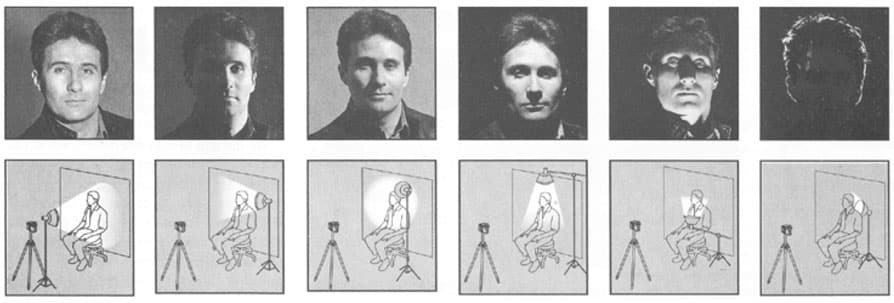
Berikut ini beberapa contoh peletakkan posisi lampu dan foto yang dihasilkan.
Posisi Lampu dan hasil fotonya
Posisi Lampu dan hasil fotonya - Klik pada foto untuk melihat lebih besar.


Saturday, September 28, 2013

Terminology in lighting.

1.      lamp: lominous source, there is gets kind, type kind, as par 38, halogen, spot, follow light, focus light,  etc..
2.       holder : dudukan puts off the light.
3.      cable: penghantar is electricity.
4.       dimmer : apparatus to manage light intensity.
5.       main light : functioning light to light bandstand as a whole.
6.       foot light : lamp to light bandstand underside. 
7.       wing light : lamp to light bandstand flank part.
8.       light's cadre : lamp to light bandstand of front aim.
9.       back light : lamp to light bandstand rear end, usually been placed at rearwards bandstand.
10.  silhouette light : lamp to form siluet on backdrop.
11.  upper light : lamp for menerang bandstand middle part, usually been placed apropos on the stage.
12.  tools : lightings supporting equipment, e.g. circuit breaker (fuse), forceps, snip, isolator, solder, mallet, tespen, cutter, avometer, saklar, stopcontact, jumper, etc..
13.  break even light , lamp that at quits ala installation or each. (1 channel 1 lamp)
14.  light's parallel , lamp that at parallel ala installation (1 channel some lamp).
 
As have already at above reveal, classically that things is one in a general way have to be known by lightingman, hereafter good don't it tatacahaya hinges on grasp, experience and creativity of lightingman . In essentials, if wants to become ‘ lightingman  unmitigated ’,  You shall there are many study and trying( trial and error )

BROADCASTING IN INDONESIA

Perkembangan pertelevisian di indonesia.

    Tahun 1989 adalah tonggak perkembangan penyiaran (broadcasting) di Indonesia setelah hampir 37 tahun TVRI menjadi single fighter dalam berkiprah di dunia pertelevisian yakni dengan mengudaranya siaran televise swasta pertama di Indonesia yakni Rajawali Citra Televisi Indonesia (RCTI) yang menyelenggarakan siaran terbatas. Kehadiran televise swasta tersebut mendapat sambutan gempita dari masyarakat khususnya di daerah-daerah yang terjangkau oleh siaran RCTI kehadiran TV swasta tersebut di awali dan sebagai konsekuensi terbitnya SK Menteri Penerangan RI Nomor : 190A / Kep/ Menpen / 1987 tentang saluran siaran terbatas, yang membuka peluang bagi televisi swasta untuk beroperasi.Adapun setelah mengudaranya RCTI pada Agustus 1989, maka berturut-turut muncul TV-TV swasta lainnya di Indonesia, adalah SCTV (24 / 8 / 1990), TPI (23 / 1/ 1991), ANTV (7/ 3/ 1993), Indosiar (11 /1/ 1995), Metro TV (25 / 11 2000), Trans TV (25 /11/ 2001), dan Lativi (17 / 1 / 2002). Selain itu, muncul pula TV 7 dan Global TV. Jumlah televisi swasta nasional belum mencakup tv lokal-regional, seperti Bali TV, Jogya TV, RBTV, TV Borobudur Semarang, JTV Surabaya, Bandung TV, dan lain-lain.
Dengan hadirnya beberapa televisi nasional dan juga beberapa tv lokal dan komunitas, menambah maraknya bisnis televisi di tanah air, dan pada gilirannya masyarakat akan di hadapkan pada beragam pilihan program yang menarik. Pada era orde baru yang lalu masyarakat hanya memiliki satu pilihan siaran televisi pemerintah yakni TVRI. TVRI yang di lahirkan pada tanggal 24 Agustus 1962, tercatat sebagai televisi siaran terristerial yang pertama dan satu-satunya milik pemerintah hingga awal tahun 1990. pada awalnya TVRI adalah medium pemerintahan Soekarno yang berda pad sebuah yayasan untuk memperkenalkan bangsa Indonesia pada dunia luar. Adapun kelahirannya tidak lepas dari upaya menegakkan eksistensi bangsa Indonesia melalui event Pekan Olahraga Asian Games pada tahun1962. setelah Asian Games sukses di gelar, tepatnya pada Oktober 1963, struktur organisasi TVRI terbentuk. Dengan status yayasan, TVRI bertanggung jawab kepada Departemen Penerangan untuk isi program, tetapi otonom pada pendanaan. Adapun dana operasional TVRI di galang melalui iuran kepemilikan pesawat televisi di masyarakat.


SEJARAH PENYIARAN DUNIA


        Sejarah media penyiaran dunia dapat dibagi menjadi dua bagian yaitu sejarah media penyiaran sebagai penemuan teknologi dan sejarah media penyiaran sebagai suatu industri. Sejarah media penyiaran sebagai penemuan teknologi berawal dari ditemukannya radio oleh para ahli teknik di Eropa dan Amerika. Sejarah media penyiaran sebagai suatu industri dimulai di Amerika. Dengan demikian, mempelajari sejarah media penyiaran dunia, baik sebagai penemuan teknologi maupun industri nyaris hampir sama dengan mempelajari sejarah penyiaran di Amerika Serikat. Pada bagian ini, akan dibahas sejarah penyiaran dunia dan juga sejarah penyiaran di Indonesia.
Sejarah media penyiaran dunia dimulai ketika ahli fisika Jerman bernama Heinrich Hertz pada tahun 1887 berhasil mengirim dan menerima gelombang radio. Upaya Hertz itu kemudian dilanjutkan oleh Guglielmo Marconi (1874-1937) dari Italia yang sukses mengirimkan sinyal morse –berupa titik dan garis- dari sebuah pemancar kepada suatu alat penerima. Sinyal yang dikirimkan Marconi itu berhasil menyeberangi Samudera Atlantik pada tahun 1901 dengan menggunakan gelombang elektromagnetik 


        Sebelum Perang Dunia I meletus, Reginald Fessenden dengan bantuan perusahaan General Electric (GE) Corporation Amerika berhasil menciptakan pembangkit gelombang radio kecepatan tinggi yang dapat mengirimkan suara manusia dan juga musik. Sementara itu tabung hampa udara yang ketika itu bernama audion berhasil pula diciptakan. Penemuan audion menjadikan penerimaan gelombang radio menjadi lebih mudah.
Radio awalnya cenderung diremehkan dan perhatian kepada penemuan baru itu hanya terpusat sebagai alat teknologi transmisi. Radio lebih banyak digunakan oleh militer dan pemerintahan untuk kebutuhan penyampaian informasi dan berita. Radio lebih banyak dimanfaatkan para penguasa untuk tujuan yang berkaitan dengan ideologi dan politik secara umum. 


                Peran radio dalam menyampaikan pesan mulai diakui pada tahun 1909 ketika informasi yang dikirimkan melalui radio berhasil menyelamatkan seluruh penumpang kapal laut yang mengalami kecelakaan dan tenggelam. Radio menjadi medium yang teruji dalam menyampaikan informasi yang cepat dan akurat sehingga kemudian semua orang mulai melirik media ini.
Pesawat radio yang pertama kali diciptakan, memiliki bentuk yang besar dan tidak menarik serta sulit digunakan karena menggunakan tenaga listrik dari baterai yang berukuran besar. Menggunakan pesawat radio ketika itu, membutuhkan kesabaran dan pengetahuan elektronik yang memadai.
Sedangkan Sejarah penyiaran suatu industri bermula saat seorang pengusaha tersukses di Dunia yang sekarang baik sebelumnya, maupun selanjutnya mengembangkan usaha mereka yang tidak pernah terpikirkan orang atau hanya karena mereka-mereka ini hanya lagi Hoki ???


Terima Kasihhh,.,. Semoga Bermanfaat  ;) 

Followers